
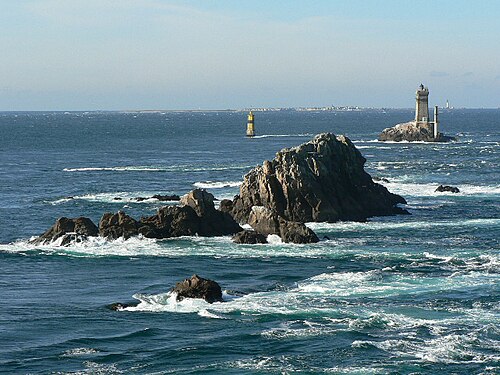
A tidal race crossed at slack water in fair weather is a formality. The same race with wind against a 5 kn stream becomes a short, steep, breaking sea that can put a yacht in trouble. The difference almost always comes down to timing.
Why the sea builds
When the wind blows against the stream, waves running into the current are slowed down: they shorten and steepen. For the same wind strength the sea becomes higher, steeper and more confused. The stronger the stream and the steadier the wind, the worse it gets. In the Raz de Sein the stream can reach 6 to 7 kn at springs.
Time it on the turn
Streams in the Breton channels are referenced to high water at a standard port, usually Brest. For a northbound passage through the Raz de Sein and the Chenal du Four, aim to arrive at the start of the fair stream, ideally at slack water, to use the stream without facing its peak.
Example from SkipperBrief’s Lorient → Scilly route: the stream sets north from about HW Brest +5 h 45 to HW Brest −0 h 30. With HW Brest at 06:31, the northbound window opens around 12:16 and closes around 18:29.
These times are indicative. Check them in the official tidal stream atlas and the sailing directions, which detail variations inside each channel.
The decision rule
| Situation | Decision |
|---|---|
| Wind and stream in the same direction | GO: longer sea, higher speed over ground |
| Light opposing wind (< 8 kn) | Caution: chop, stay alert |
| Opposing wind > 15 kn and stream ≥ 1.5 kn | NO GO at this time: wait for the turn or go round |
Build the route around the gate
- Work out your arrival time at the entrance of the race, then work back to your departure time.
- Set a decision point upstream (for example Penmarc’h for the Raz de Sein) with a maximum acceptable delay.
- Have the engine ready and the mainsail reefed before going in.
- Identify a waiting anchorage: Sainte-Évette, Camaret or L’Aber-Ildut depending on direction.
What SkipperBrief does
For each tidal gate, SkipperBrief works out the stream direction at your passage time from the reference tides, flags foul stream and wind against tide, and shows the fair-stream windows. Move the departure time and you see straight away whether you arrive at slack water.
Cast off with peace of mind
Plan your next passage with SkipperBrief: route, weather by leg, tides, a GO / NO GO verdict and a printable roadbook PDF, on iPhone.

Decision aid: the skipper remains solely responsible.
Leave a Reply